
Modernisation & Redesign of Existing Products
Extend the life of products so they can continue to perform reliably
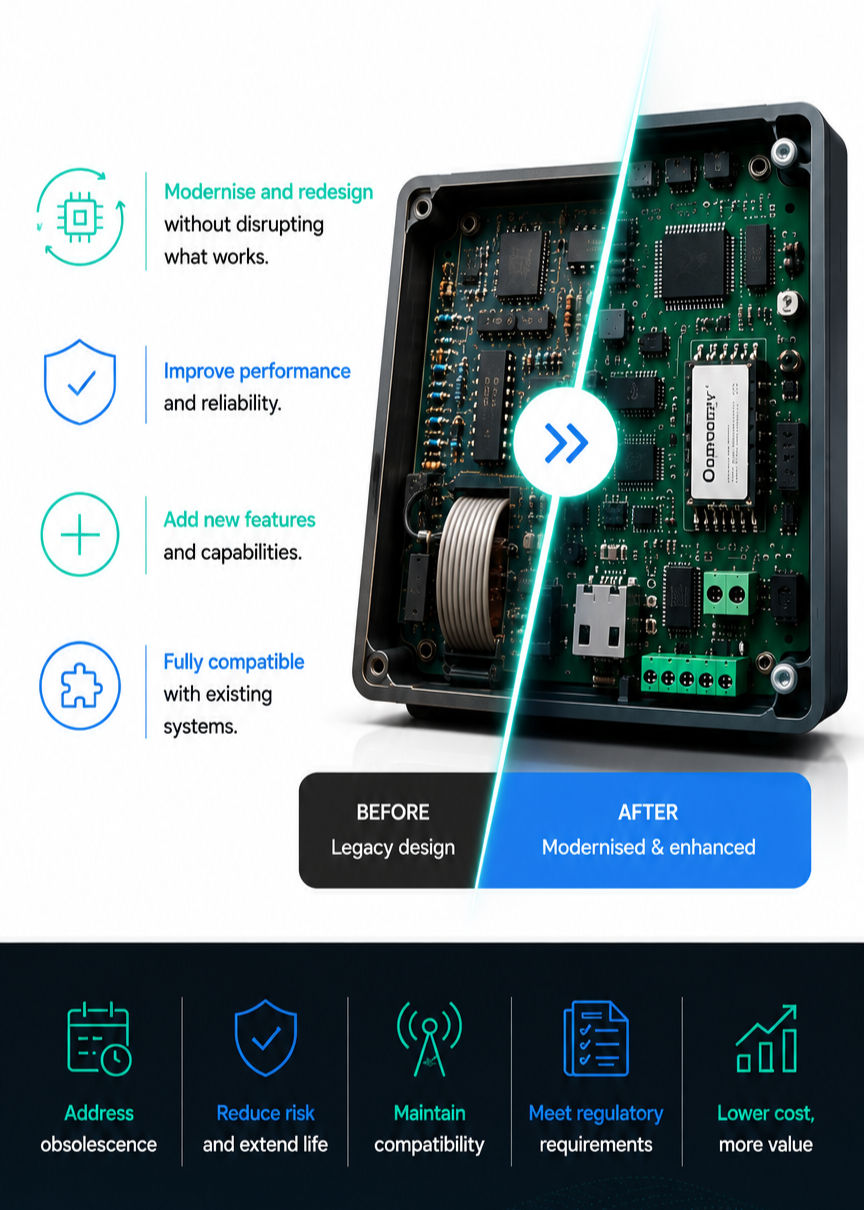
Product upgrades without breaking what already works
Modernisation and redesign allows you to update, improve or replace electronic products that are already deployed without disrupting what currently works.
This service is for you if you have an existing product that must continue operating reliably, but is under pressure from component obsolescence, regulatory change, reliability concerns, or new functional requirements.
You may be facing end-of-life components, ageing architectures, increasing failure rates, or customers asking for capabilities the original design was never intended to support. The challenge is making necessary changes without introducing new risks into systems that are already in use.
Innovisory approaches modernisation with one principle in mind: improve what needs improving, while protecting what already works.
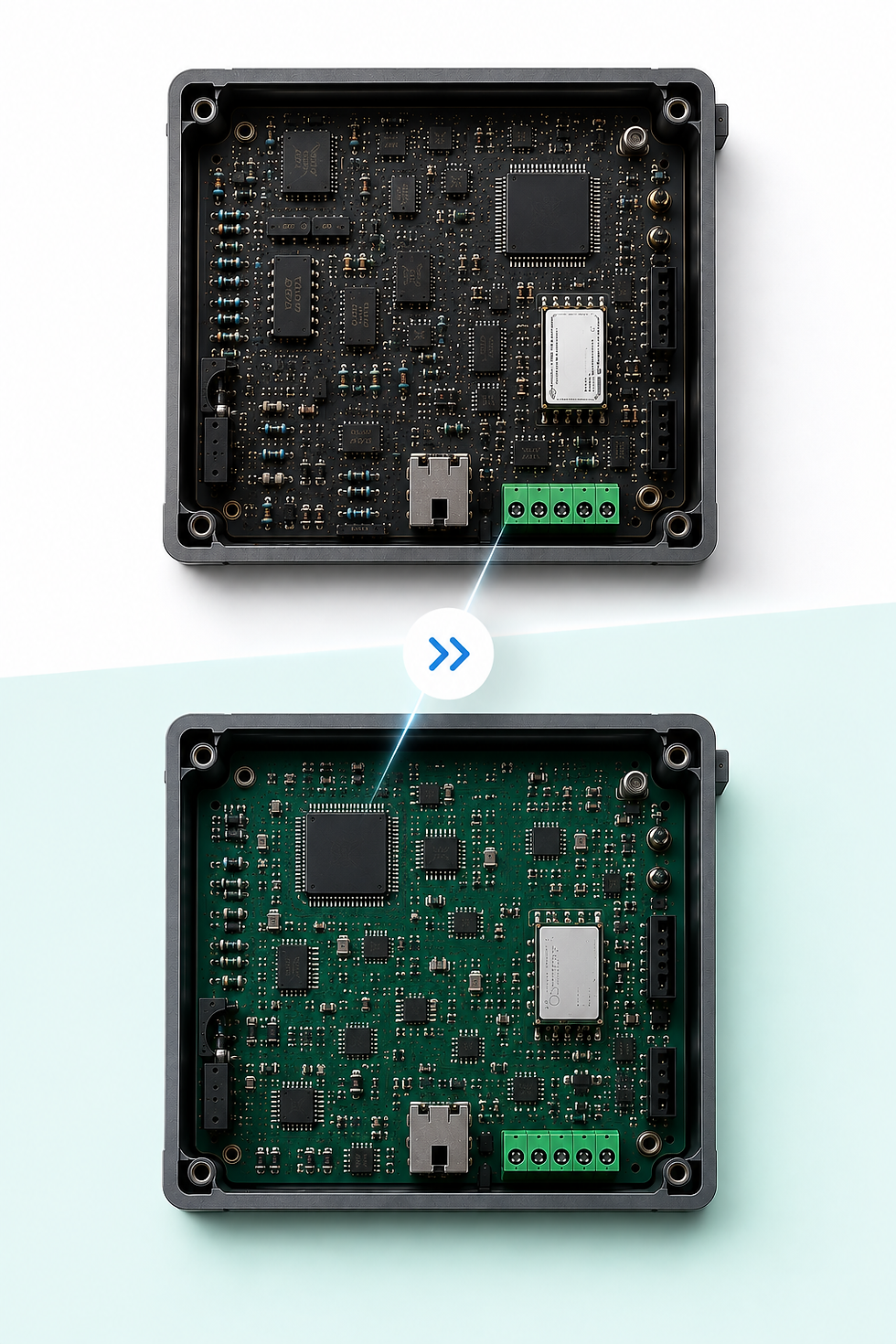
The challenges of modernising existing products
Modernisation rarely fails because the new technology is wrong. It fails because the existing system wasn’t fully understood before changes were made.
It could be anything from a component substitution that appears straightforward on paper but alters behaviour under temperature to firmware changes interacting unexpectedly with older hardware variants. Or a new feature that increases power draw or EMC exposure in ways that weren’t anticipated.
When responsibility is split across teams or suppliers, changes are made independently of the system as a whole. The consequences only become visible when something breaks and that's typically in the field.
At that point, you’re no longer upgrading. You’re managing unexpected issues.
Innovisory avoids this by treating modernisation as a system-level exercise from the outset. Before changing anything, we understand what exists, how it behaves, and where the real dependencies lie. Changes are then designed and staged deliberately, with reliability, compliance and deployment continuity in mind.
Our Approach
One team. One system.
One point of accountability.
Modernisation requires different judgement to new product development. The constraints are tighter, the margin for error is smaller, and the existing systems must be protected.
Understand before changing
We start by mapping the current system including hardware, firmware, behaviour, deployment variants and known issues, so decisions are grounded in reality, and not assumed.
Plan around risk
We identify where change could create unintended consequences: field reliability, compatibility, certification, manufacturing continuity. The migration plan is shaped around minimising those risks.
Control the transition
Work is delivered in controlled phases with clear validation points. Existing deployments remain stable while changes are proven.
Maintain compatibility where required
Where necessary, we design transitions that allow legacy and updated versions to coexist during rollout, reducing operational disruption.
Single accountability across the migration
One team owns the technical changes, validation strategy, manufacturing transition and deployment planning. You’re not left coordinating the gaps.

How This Service Helps You
Modernisation done properly gives you more than revised hardware or updated firmware.
It helps you:
-
Understand what can and cannot be changed safely before committing to a direction
-
Reduce the risk of field failures or compatibility issues by addressing dependencies early
-
Protect certification and compliance status through early impact assessment
-
Manage manufacturing transition smoothly with clear documentation and validation plans
-
Explain the approach with confidence to customers, operations teams and senior stakeholders
For many clients, the real value lies in avoiding the disruption, cost and reputational damage that come from discovering problems after deployment.
What Our Modernisation Projects Include
Every project is different, but common elements include:
Current system assessment
Documentation review, analysis of deployed variants, understanding functionality of existing products and identification of hidden dependencies and limitations.
Obsolescence and compliance review
Component lifecycle analysis, regulatory impact assessment and certification implications.
Migration architecture and planning
Clear definition of what changes, what remains, how rollout happens and how validation will be handled.
Feasibility assessment
Component substitutions and additional circuit design, PCB redesign, reliability improvements or functional extensions, with consideration for existing enclosures and interfaces.
Options & trade-offs
Code updates including new functionality, improved diagnostics, compatibility management and defined update/rollback strategy.
Testing and validation
Functional, regression, environmental and reliability testing, plus field trial planning where appropriate.
Manufacturing and deployment transition
Updated documentation, process changes, test fixture updates and phased rollout planning.
Ongoing support
Monitoring, issue resolution and structured support for future evolution.
Real-World Engineering
We’ve supported modernisation projects across industrial and commercial environments where continuity of supply and reliability were critical.
Below are selected examples showing how we’ve handled obsolescence, compliance-driven redesign and reliability improvement without disrupting deployed systems.


FAQs
Sometimes, but rarely without checking the consequences.
Even components that appear equivalent on a datasheet can behave differently under temperature, load or long-term stress and can impact the product's compliance (EMC, for example). That may not show up in bench testing but can cause field issues later.
We assess whether substitution is genuinely safe, or whether circuit changes, firmware updates or additional validation are required. Our goal for you is safe and sustainable improvement.
By understanding it first.
We analyse the existing system; hardware, firmware and functional behaviour of all deployed variants before determining the required design changes. That includes reviewing documentation and identifying dependencies that aren’t always obvious.Changes are then staged, validated and, where necessary, designed with rollback or compatibility in mind.
That’s quite common.
We design migration paths that allow legacy and updated versions to coexist during rollout. This reduces operational risk and allows validation of the product in the real-world before full commitment.
By assessing the impact early.
Some changes require full re-certification. Others can be managed through change control or supplementary testing. We identify the implications at the planning stage so there are no surprises.
Where re-certification is necessary, we design with that in mind from the outset.
Why Clients Choose Innovisory
We own the whole problem – Not just feasibility, but the complete path from concept to production
We design for long-term reliability – Systems that work in the real world, not just laboratories
We think at system level – Hardware, firmware, software, cloud and compliance as one integrated solution
We reduce delivery risk – Through structured process and system-level thinking
We bring 30+ years of experience – In industrial systems that must perform reliably for years
We deliver certainty, not just engineering – Clear answers, defensible recommendations, and confidence to proceed