
Feasibility, Architecture, Prototyping
For when you need to know what’s possible.

See where your idea could go
Early-stage ideas often carry a mix of opportunity and uncertainty.
You may have a clear concept, or just the outline of one. Either way, you know that before committing significant time, budget or credibility, you need to understand what’s feasible, what the system should look like, and the risks it carries.
This service helps you answer those questions.
Innovisory works with you to turn early-stage thinking into a clear, structured view of the system by defining requirements, shaping architecture and testing key assumptions where needed so you can decide what to do next with confidence.
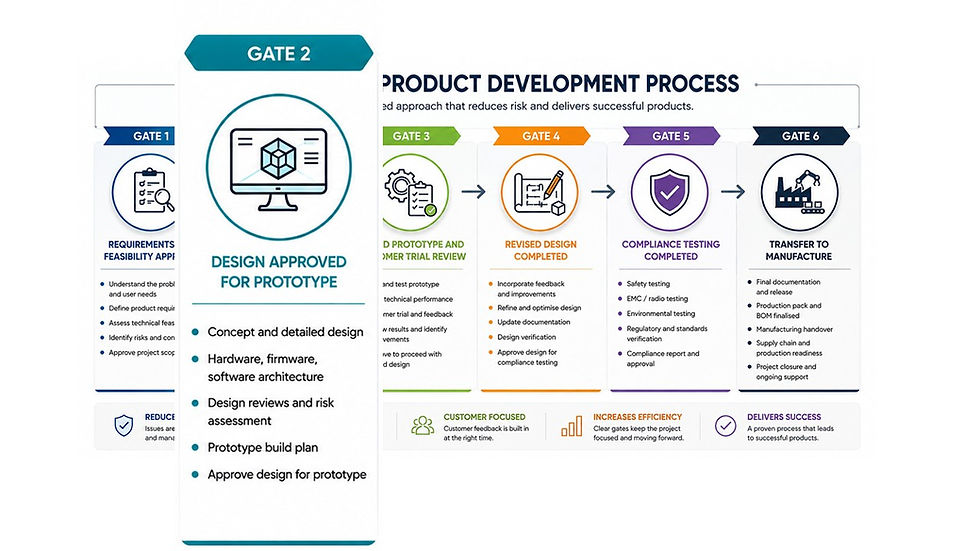
The reality of early-stage product decisions
Most teams recognise the value of early prototyping and feasibility work.
In practice, though, it’s often compressed, partial, or focused on proving that something can be built, rather than understanding how the whole system will behave in the real world.
A prototype may demonstrate core functionality, but still leave important questions unanswered around reliability, compliance, manufacturability, long-term performance, or how different parts of the system interact.
When a project is under time pressure, it’s easy to move forward with those gaps still in place. Early decisions get made without the full context, and their consequences only become clear later, when they are harder and more expensive to address. Fundamentally, feasibility and prototyping studies are about giving you enough clarity to move forward with confidence.
Our Approach
One team. One system.
One point of accountability.
At this stage, the goal is to make the right decisions before significant time and cost are committed.
We use feasibility, architecture and prototyping to reduce uncertainty, expose risks early, and give you the confidence to commit (or change direction) before significant investment.
Understand the problem in context
We clarify what the system needs to do, how it will be used, and the constraints it must operate within in the real-world level.
Look at the system as a whole
Hardware, firmware, connectivity, data, compliance and manufacturing are considered together, so dependencies and constraints are identified early.
Surface and test assumptions
We identify what is known, what isn’t, and what needs to be proven and then focus effort on reducing the most important uncertainties.
Define architecture before build
We establish how the system should be structured, including key decisions and interfaces, so development isn’t driven by guesswork.
Prototype with purpose
Where prototyping is needed, it is used to answer specific questions and not purely to demonstrate functionality.
One team, one view
All of this is done with a joined-up view of the system, so decisions are consistent and nothing falls between disciplines.
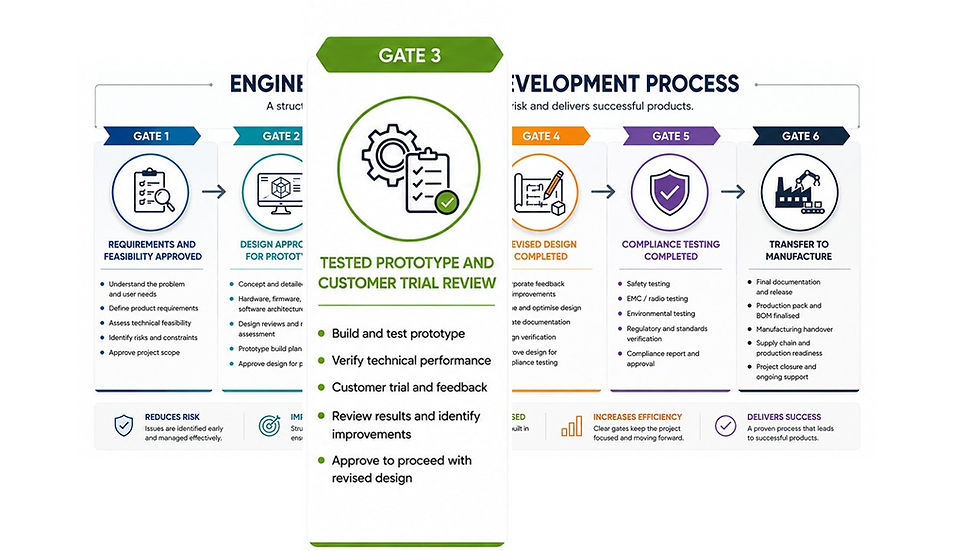
How This Service Helps You
This phase gives you a clear, practical foundation for moving forward with your product.
-
Clarity on what will work, what won’t, and where the constraints sit
-
Key risks identified early, before they become expensive or difficult to fix
-
Decisions grounded in evidence rather than assumptions (or optimism)
-
Reduced likelihood of rework caused by premature or misaligned builds
-
A clear basis for deciding whether and how to proceed In short, uncertainty is replaced with a structured, defensible view of how the system should move forward.
What Our Phase Includes
The exact scope varies, but this phase focuses on understanding the system and reducing the key uncertainties.
Requirements & use cases
Clarifying what the system needs to do, how it will be used, and the conditions it must operate within.
Constraints & dependencies
Identifying technical limits, assumptions and interactions across hardware, firmware, connectivity, data and environment.
System architecture
Defining how the system is structured, including key components, interfaces and data flows.
Feasibility assessment
Evaluating critical elements such as sensing, connectivity, power and performance to confirm what is realistically achievable.
Options & trade-offs
Exploring different approaches and their implications to support informed design decisions.
Targeted prototyping
Testing specific assumptions or behaviours where practical validation is needed.
Risk identification
Highlighting risks across reliability, compliance, manufacturing and real-world operation while they are still in their infancy.
Cost & timeline guidance
Providing indicative ranges based on complexity, constraints and the likely development path.
The outcome is a clear, structured understanding of the system and what is required before moving into full development.
Real-World Engineering
We’ve worked on early-stage projects across industrial and commercial environments where the priority was to understand what would actually work before committing further.
Below are a few examples that show how we’ve used feasibility work, system architecture and targeted prototyping to test ideas, uncover constraints and shape solutions that could be delivered and supported in the real world.


FAQs
n some cases, that’s reasonable. The risk is that a prototype proves something can be built, without showing how it will behave in the real world. This phase focuses on understanding the system first, so early decisions don’t create problems later.
That’s exactly what this phase is for.
We help you turn an initial idea or use case into a clear set of requirements, constraints and priorities that can guide development.
You leave with a clear view of the system, the key risks, and a defined approach.
That typically includes requirements, architecture, technical direction and a basis for costs and timelines.
It depends on complexity, but most feasibility and architecture phases run over a few weeks, not months.
The focus is on answering the important questions quickly.
Yes. We often work with internal engineers, adding system-level perspective and helping bring structure to early-stage decisions.
You’ll be in a position to decide whether to proceed, what needs to change, and how the next stage should be structured.
If you continue working with us, the work transitions naturally into development. If not, you still have a clear, usable foundation.
Why Clients Choose Innovisory
We own the whole problem – Not just feasibility, but the complete path from concept to production
We design for long-term reliability – Systems that work in the real world, not just laboratories
We think at system level – Hardware, firmware, software, cloud and compliance as one integrated solution
We reduce delivery risk – Through structured process and system-level thinking
We bring 30+ years of experience – In industrial systems that must perform reliably for years
We deliver certainty, not just engineering – Clear answers, defensible recommendations, and confidence to proceed